
A 2026 pilot crossover study found that precisely timed auditory stimulation — delivered during the "up phase" of slow-wave oscillations — measurably enhanced slow-wave brain activity during deep sleep in a clinical population. That same slow-wave activity, known in research as NREM Stage 3, drives what scientists call the glymphatic system: the brain's overnight waste-clearance mechanism. A second 2026 study used near-infrared spectroscopy wearables to directly observe the brain water dynamics tied to this glymphatic clearing, confirming that deep sleep is its primary driver. Understanding how to protect and deepen this stage of sleep has become one of the most clinically active areas of sleep science.
What Is Deep Sleep and Why Does It Matter?
Sleep is not uniform. A full night's rest cycles through several distinct stages — NREM 1, NREM 2, NREM 3 (slow-wave sleep), and REM — roughly every 90 minutes. Stage 3, or slow-wave sleep (SWS), is characterized by the large, synchronized brain waves visible on a polysomnography (EEG) recording. During this phase, heart rate and body temperature drop to their lowest, human growth hormone is secreted in a significant pulse, and the brain consolidates declarative memories laid down during the day.
Deep sleep is also when the glymphatic system is most active. This network of channels surrounding the brain's blood vessels expands during slow-wave sleep, allowing cerebrospinal fluid to flush metabolic byproducts — including amyloid-beta and tau proteins associated with Alzheimer's disease — that accumulate during waking hours. Disrupted or insufficient deep sleep has been linked in population studies to elevated dementia risk, impaired immune function, metabolic dysregulation, and reduced emotional resilience.
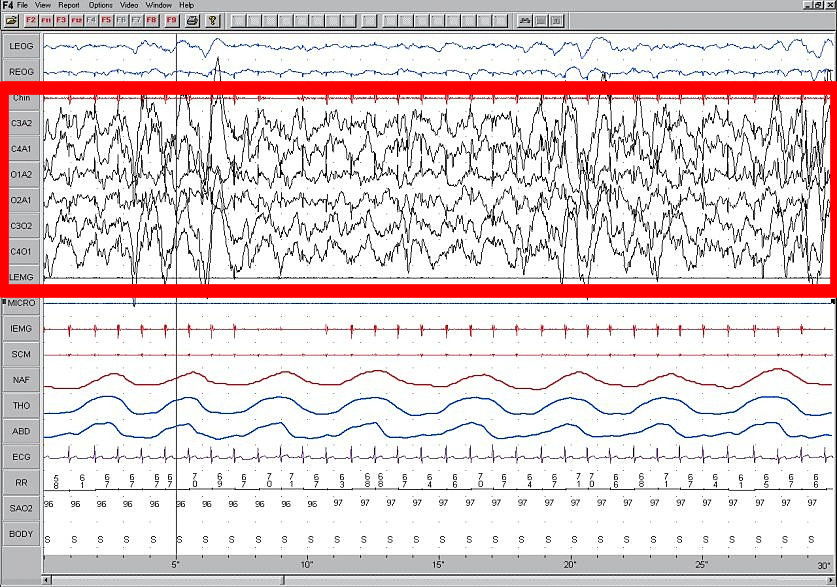
Image: Sleep EEG Stage 4.jpg — (Public domain), via Wikimedia Commons
Sleep Timing and Circadian Alignment
Deep sleep is heavily front-loaded in the night. The first two 90-minute sleep cycles — roughly the first three hours after sleep onset — contain the longest and deepest periods of slow-wave sleep. As the night progresses, REM sleep dominates and deep sleep shrinks. This means that the timing of sleep onset has an outsized effect on how much deep sleep you actually obtain.
Going to bed when core body temperature begins its natural evening decline — typically between 10 p.m. and midnight for adults with a conventional schedule — aligns sleep onset with the hormonal conditions that favor NREM Stage 3. Melatonin, produced by the pineal gland in response to darkness, signals the brain that nighttime has arrived. Its production peaks in the middle of the night and drops sharply before morning. Light exposure management in the 2 hours before bed — avoiding bright overhead lights and blue-wavelength screens — is one of the highest-leverage and lowest-cost interventions available, because it protects the natural melatonin onset that cues deep sleep.

Image: Melatonin production in 24 hour cycle.jpg — Rechargeenergy (CC BY-SA 4.0), via Wikimedia Commons
Temperature: The Most Underrated Deep Sleep Factor
Core body temperature must drop 1–2°F (about 1°C) for sleep onset to occur, and it continues declining through deep sleep. Research consistently finds that cooler bedroom environments — typically between 60°F and 67°F (15.5°C to 19.5°C) — facilitate this natural drop, reducing sleep latency and increasing slow-wave sleep duration. Sleeping in a room that is too warm is one of the most common and correctable causes of fragmented deep sleep.
Warm baths or showers taken 1–2 hours before bed exploit a counterintuitive physiological mechanism: warming the skin accelerates heat loss from the body's core via peripheral vasodilation (widening of surface blood vessels), triggering the drop in core temperature that promotes sleep onset and deep sleep. This approach is supported by a substantial body of controlled research and can be combined with a cooler bedroom for a synergistic effect.
Auditory Stimulation: What the 2026 Research Shows
One of the most active areas of current sleep research is phase-targeted auditory stimulation (PTAS) — delivering soft sounds at precisely the right moment in the slow-wave oscillation cycle to reinforce it. A 2026 pilot crossover study applied this approach in a Huntington's disease population and found that the intervention enhanced slow-wave activity during sleep. Separately, a 2025 narrative review of music and sleep found that consistent, low-tempo acoustic backgrounds (around 60 beats per minute, with minimal variation) were associated with reduced sleep latency and improved sleep quality across adult populations.
Pink noise — a sound spectrum that weights lower frequencies more heavily than white noise — has been specifically studied for its potential to amplify slow-wave oscillations during sleep. While PTAS using real-time EEG detection remains an experimental technique requiring specialized equipment, pink noise playback is freely accessible via smartphone apps and consumer devices. The evidence for pink noise is encouraging but not conclusive; it is a low-risk addition to an existing sleep hygiene routine, not a primary intervention.
Exercise, Diet, and Alcohol
Aerobic exercise — particularly moderate-intensity cardio performed earlier in the day — is among the most reliably documented ways to increase slow-wave sleep the following night. The effect appears dose-dependent up to a point. Late-evening high-intensity exercise can delay sleep onset in some individuals by elevating core temperature and cortisol, the effects of which may persist for several hours post-workout.
Diet timing is a secondary but meaningful factor. Large meals within 2–3 hours of bedtime raise core body temperature and divert blood flow to digestion, both of which compete with the physiological conditions for deep sleep. Alcohol deserves particular attention: while it speeds sleep onset and briefly increases NREM 1 and NREM 2, it substantially suppresses slow-wave sleep in the second half of the night, producing fragmented, non-restorative rest. The home-based deep sleep modulation study published in 2026 specifically noted the importance of controlling confounding lifestyle factors — including alcohol — in any serious program to improve deep sleep.
| Intervention | Effect on Deep Sleep | Evidence Strength |
|---|---|---|
| Consistent bedtime | Anchors circadian rhythm; maximizes early-night SWS window | Very strong |
| Cool bedroom (60–67°F) | Facilitates core temperature drop required for SWS | Strong |
| Evening light avoidance | Protects melatonin onset; aligns circadian phase | Strong |
| Warm bath 1–2 hrs before bed | Accelerates core temperature drop via vasodilation | Strong |
| Moderate aerobic exercise | Increases slow-wave sleep the following night | Strong |
| Alcohol avoidance | Prevents SWS suppression in the second half of night | Very strong |
| Pink noise | May amplify slow-wave oscillations; accessible, low risk | Moderate |
| Phase-targeted auditory stimulation | Enhances slow-wave oscillations; requires specialized equipment | Preliminary (2026) |
Frequently Asked Questions
How much deep sleep do adults actually need?
Most adults spend roughly 13–23% of total sleep time in NREM Stage 3. For a 7–8 hour night, that is approximately 60–90 minutes of slow-wave sleep. This proportion naturally declines with age — adults over 60 typically spend under 10% of their sleep in Stage 3 — which is one reason sleep becomes less restorative over time. If you use a consumer wearable to track sleep stages, treat the figures as relative trends rather than precise measurements; consumer devices estimate sleep stages from movement and heart rate, not EEG, and they are known to overestimate light sleep and underestimate deep sleep in some users.
Does melatonin supplementation actually increase deep sleep?
The evidence is more nuanced than supplement marketing suggests. Melatonin is well-established for shifting circadian phase — it helps people fall asleep earlier, which indirectly provides more time in the first SWS-rich part of the night. But melatonin does not directly increase the intensity or duration of deep sleep by itself. Low doses (0.5–1 mg), taken 1–2 hours before desired bedtime, appear more physiologically appropriate than the 5–10 mg doses commonly sold; higher doses can blunt the natural melatonin rise the following evening and produce morning grogginess without proportional sleep benefit.
Can weekend "recovery sleep" make up for a week of poor deep sleep?
Partial recovery is real but incomplete. After sleep deprivation, the brain prioritizes slow-wave sleep during the first recovery night — a phenomenon called slow-wave rebound. However, chronic sleep restriction over months or years is not fully reversed by a few nights of extended sleep. The most durable strategy is consistency: the same bedtime and wake time throughout the week, with a sleep window long enough to complete 4–5 full 90-minute cycles naturally. Sleeping in on weekends provides some benefit but also shifts the circadian clock, which can make Monday morning harder.
Bottom Line
Deep sleep is not a passive state you stumble into — it is an actively regulated biological process that can be meaningfully supported through behavioral and environmental choices. The highest-leverage interventions are consistent sleep timing, a cool bedroom, and alcohol avoidance, all of which have strong evidence and zero cost. Emerging 2026 research on phase-targeted auditory stimulation shows that slow-wave oscillations can be actively enhanced, though this technology is not yet consumer-ready. We recommend building the behavioral foundation first — timing, temperature, and light management — before exploring supplements or devices, and tracking your sleep trends over weeks rather than obsessing over any single night's numbers.
Sources & References:
Phase-targeted auditory stimulation enhances slow-wave activity during sleep in Huntington's disease: pilot crossover study (PubMed, 2026)
Elements of music that work to improve sleep: a narrative review (PubMed, 2025)
Home-based deep sleep modulation in Parkinson's disease: extension study (PubMed, 2026)
Soft wearable NIRS system detecting brain water dynamics linked to glymphatic activity during sleep (PubMed, 2026)
Disclaimer: This article is for informational purposes only and does not constitute medical advice. Always consult a qualified healthcare professional before making health decisions.