
Every cell in your body carries a biological clock embedded in its chromosomes — and new research suggests that understanding how it works may be one of the most powerful steps you can take toward a longer, healthier life. A 2024 multicenter study published in International Journal of Molecular Sciences by Dratwa-Kuzmin and colleagues examined telomere length alongside HLA genetic markers in diverse longevity cohorts, finding that telomere dynamics are meaningfully associated with lifespan outcomes across populations. But what exactly are telomeres, and what can you actually do about them?
What Telomeres Are and Why They Matter
Telomeres are repetitive DNA sequences (the motif TTAGGG in humans) that cap the ends of every chromosome, much like the plastic tips on a shoelace. Their job is to protect chromosomal DNA from degradation and to prevent chromosomes from fusing with one another during cell division. Each time a cell divides, telomeres shorten slightly — DNA replication cannot fully copy the very end of a linear chromosome, so a small segment is lost with every cycle. When telomeres become critically short, cells either enter a dormant state called senescence or undergo programmed cell death (apoptosis), and the tissues they support begin to lose regenerative capacity.
This progressive shortening is recognized as one of the fundamental hallmarks of biological aging — a process distinct from the simple passage of calendar years. A 60-year-old with longer-than-average telomeres may, at the cellular level, function more like a 50-year-old. The reverse is equally true.
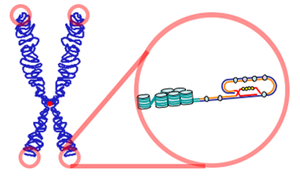
Image: File:Telomere.png — Y_tambe (CC BY-SA 3.0), via Wikimedia Commons
The Telomere–Longevity Connection: What Research Shows
The 2024 multicenter study (PMID 39273401) confirmed a consistent pattern across cohorts: individuals with longer leukocyte telomere length appear at higher rates in longer-lived populations, while critically short telomeres are enriched among those with elevated rates of age-related disease. The relationship is not perfectly linear — genetics, including HLA variants associated with immune function, moderates the picture — but the signal across diverse populations is real and reproducible.
A landmark 2023 study in Nature Medicine by Tian and colleagues (PMID 37024597) demonstrated that biological aging is not uniform across organ systems. Kidneys, livers, hearts, and brains can age at markedly different rates within the same individual, and organs that age faster than the body's average predict elevated risk of chronic disease and mortality — even after controlling for chronological age and conventional risk factors. Telomere length in circulating immune cells is one of the proxy biomarkers used to estimate this systemic biological age.
The practical insight from both lines of research is the same: biological age, not years lived, determines health trajectory — and it is more modifiable than previously assumed.
How Lifestyle Choices Shape Telomere Length
A 2020 comprehensive review by Ekmekcioglu in Critical Reviews in Food Science and Nutrition (PMID 31631676) mapped the mechanisms through which nutrition influences longevity, including its effects on telomere integrity. Several lifestyle factors consistently emerge across the evidence base:
- Caloric balance: Persistent caloric excess accelerates metabolic stress and oxidative damage to DNA, including telomeric regions. Avoiding chronic overfeeding is one of the most replicated interventions for preserving cellular health across species studied.
- Dietary patterns: Diets high in antioxidants, fiber, and anti-inflammatory compounds — particularly Mediterranean and plant-rich eating patterns — correlate with slower telomere attrition in large observational cohorts.
- Nutrient adequacy: Folate, vitamins B12, C, D, and E, along with minerals such as zinc and magnesium, play documented roles in DNA repair and protection against oxidative damage that would otherwise accelerate telomere shortening.
- Omega-3 fatty acids: Higher circulating omega-3 levels have been associated with slower telomere attrition in multiple cohort studies, likely through anti-inflammatory and membrane-stabilizing mechanisms.
Exercise, Sleep, and Stress: The Other Three Pillars
Beyond diet, three additional lifestyle domains show consistent associations with telomere health across the research literature:
Physical activity: Moderate-to-vigorous aerobic exercise is one of the most replicated lifestyle correlates of longer telomere length in large epidemiological studies. Consistently active adults tend to show longer telomeres than sedentary peers matched for age. The mechanisms likely involve reduced systemic oxidative stress, lower levels of chronic inflammation, and improved mitochondrial function — all processes that reduce the pace of telomere erosion between cell divisions.
Sleep quality and duration: Short or disrupted sleep elevates cortisol, increases inflammatory markers, and promotes oxidative stress — conditions that accelerate telomere shortening. Adults who chronically sleep fewer than six hours per night show patterns of accelerated biological aging across multiple biomarker studies, telomere length included.
Chronic psychological stress: Stress-related biological pathways — elevated glucocorticoids, increased systemic inflammation — directly damage DNA and reduce the activity of telomerase, the enzyme that can partially replenish telomere sequences. Studies of long-term caregivers, trauma survivors, and individuals with chronic anxiety have found shorter average telomere lengths compared to age-matched controls, a finding replicated across many independent cohorts.

Image: File:The Hallmarks of Aging.jpg — Rebelo-Marques, De Sousa Lages, Andrade, Ribeiro, Mota-Pinto, Carrilho and Espregueira-Mendes (CC BY 4.0), via Wikimedia Commons
What Telomerase Can (and Cannot) Do
Telomerase is a ribonucleoprotein enzyme that adds TTAGGG repeats back onto telomere ends. It is highly active in germ cells and some stem cell populations, but minimally active in most adult somatic cells — a biological trade-off that suppresses cancer risk (telomerase reactivation is a hallmark of most human cancers) while allowing gradual telomere attrition with age.
Certain compounds marketed to "activate telomerase" — most notably cycloastragenol, a derivative of astragalus — have shown small effects in preliminary small studies. However, no large, well-controlled clinical trial has yet demonstrated meaningful telomere lengthening or improved longevity outcomes in humans from any currently available supplement. We do not recommend any supplement specifically for telomere health based on the current evidence.
| Lifestyle Factor | Effect on Telomeres | Evidence Quality |
|---|---|---|
| Mediterranean / plant-rich diet | Slower attrition | Strong — multiple large cohorts |
| Regular aerobic exercise | Longer vs. sedentary peers | Strong — epidemiological |
| 7–9 hours quality sleep | Reduced rate of loss | Moderate — observational |
| Chronic stress | Accelerated shortening | Strong — replicated widely |
| Smoking | Significantly accelerated | Very strong — large-scale data |
| Obesity / metabolic syndrome | Accelerated attrition | Strong — multiple cohorts |
| Telomerase supplements (e.g. cycloastragenol) | Unproven in humans | Very weak — no large RCTs |
Can You Test Your Telomere Length?
Several commercial tests now offer leukocyte telomere length measurement from a blood draw, typically using quantitative PCR. These tests can provide a general indication of biological age relative to population norms, but they carry important caveats: telomere length varies meaningfully between different cell types in the same individual, measurement variability between lab runs can be significant, and a single data point cannot reveal your trajectory. Only serial measurements over years would show whether your biological aging pace is accelerating or slowing in response to lifestyle changes.
If you pursue testing, we recommend doing so through a physician who can interpret the result alongside your full metabolic, cardiovascular, and genetic risk picture — rather than treating the number in isolation.
Frequently Asked Questions
Can you actually lengthen your telomeres?
Telomerase can add length back in laboratory conditions, and at least one long-term lifestyle intervention study reported modest increases in leukocyte telomere length after five years of combined dietary, exercise, stress management, and social support changes. However, the primary achievable goal for most people is slowing the rate of shortening rather than meaningfully extending absolute length — and the available evidence strongly supports lifestyle fundamentals as the most effective tool we currently have for this purpose.
How much does genetics matter for telomere length?
Genetics plays a real role — heritability estimates for telomere length range from roughly 40 to 80 percent in twin studies, meaning people who start with shorter or longer telomeres due to inheritance tend to maintain that relative position across their lives. However, the 2024 multicenter study (PMID 39273401) underscores that genetic factors interact with environmental exposures, meaning lifestyle choices still matter significantly even against a genetic backdrop that might initially disadvantage you.
Are shorter telomeres in one organ more dangerous than another?
Organ-specific telomere biology is an active area of research. The 2023 Nature Medicine study (PMID 37024597) demonstrated that different organs age at different rates, and that accelerated aging in specific systems — particularly the heart, kidneys, and lungs — is disproportionately associated with disease risk in those same systems. Peripheral blood telomere length, what commercial tests measure, is a useful proxy for systemic biological age but does not cleanly reflect any single organ's state.
Bottom Line
Telomere length is one of the more well-validated molecular markers of biological aging, and the research linking it to longevity outcomes is increasingly robust. The practical implications are less about obsessing over a number and more about recognizing that the lifestyle decisions shown to reduce your risk of heart disease, type 2 diabetes, and cancer are also the ones most consistently associated with healthier telomere dynamics. We recommend building your habits around proven fundamentals — anti-inflammatory nutrition, regular aerobic exercise, seven to nine hours of quality sleep, and effective chronic stress management — rather than waiting for a telomere supplement that the evidence has not yet validated. That approach gives you the strongest available case for a longer healthspan, regardless of where your telomeres sit today.
Sources & References:
1. Dratwa-Kuzmin M et al. "Telomere Length, HLA, and Longevity — Results from a Multicenter Study." Int J Mol Sci. 2024;25(17):9457.
2. Ekmekcioglu C. "Nutrition and longevity — From mechanisms to uncertainties." Crit Rev Food Sci Nutr. 2020;60(18):3063–3082.
3. Tian YE et al. "Heterogeneous aging across multiple organ systems and prediction of chronic disease and mortality." Nature Medicine. 2023;29(5):1221–1231.
Disclaimer: This article is for informational purposes only and does not constitute medical advice. Always consult a qualified healthcare professional before making health decisions.