
In June 2026, clinicians in a resource-limited setting reported a four-month-old infant who arrived with subdural hematoma and seizures — ultimately traced to severe late-onset vitamin K deficiency bleeding (VKDB). The child had never received the standard newborn vitamin K injection, and the clinical team's published account (Wadoodi et al., 2026) is a stark reminder that this preventable, treatable deficiency still causes catastrophic outcomes when missed. Vitamin K is not a headline nutrient, but its role in blood coagulation, bone metabolism, and cardiovascular health makes it indispensable at every stage of life.
What Vitamin K Does in the Body
Vitamin K is a fat-soluble nutrient that functions as an essential cofactor in a biochemical cycle known as the vitamin K carboxylation reaction. The enzyme gamma-glutamylcarboxylase uses vitamin K hydroquinone (KH₂) to add a carboxyl group to certain proteins — converting inactive glutamate (Glu) residues into gamma-carboxyglutamate (Gla) residues. This activated form allows those proteins to bind calcium ions and function properly. Without adequate vitamin K, these proteins remain inactive.
The most clinically recognized of these vitamin K-dependent proteins are the coagulation factors II (prothrombin), VII, IX, and X. When vitamin K levels fall too low, the body cannot produce functional versions of these clotting factors, and bleeding — sometimes life-threatening — can result.
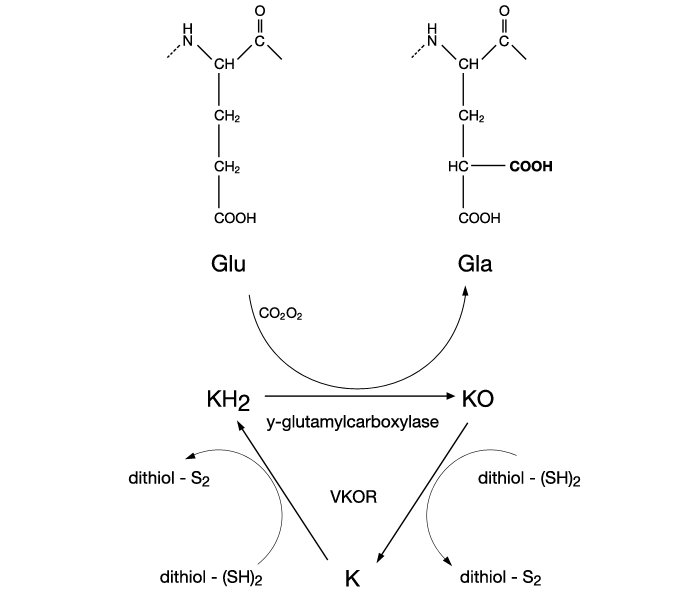
Image: Carboxylation reaction vitamin K cycle — Lomeloth (CC BY-SA 3.0), via Wikimedia Commons
Vitamin K1 vs. Vitamin K2: They Are Not Interchangeable
Two naturally occurring forms matter for human health:
- Vitamin K1 (phylloquinone) is found primarily in green leafy vegetables — kale, spinach, broccoli, Brussels sprouts, and collard greens. It is the dominant dietary form in Western diets and is most directly involved in hepatic coagulation factor production.
- Vitamin K2 (menaquinones, MK-n) is found in fermented foods and some animal products. MK-4 appears in butter, egg yolks, and liver; MK-7 is abundant in nattō (fermented soybeans). K2 appears to play a more pronounced role in bone and cardiovascular health than K1, partly because it remains active in the body for longer.
A 2026 randomized study published in Nutrients examined the sex-specific effects of supplemental MK-7 and found that the response to vitamin K2 supplementation differed between men and women in measures of body composition and adiposity markers (Bittner et al., 2026). This growing body of research suggests vitamin K2's role extends beyond clotting into metabolic health territory — though clinical guidelines have not yet fully incorporated these findings.

Image: Effect of dietary vitamin k2 intake on cardiovascular health — Lomeloth (CC BY-SA 3.0), via Wikimedia Commons
Symptoms of Vitamin K Deficiency
The hallmark sign is abnormal bleeding, but the presentation varies by severity and affected tissue:
- Easy bruising — small impacts leave disproportionate bruises
- Prolonged bleeding from cuts — wounds that take much longer than expected to clot
- Heavy menstrual bleeding — in women, periods may become unusually heavy
- Blood in urine or stool — gastrointestinal or urinary tract bleeding can signal coagulation failure
- Nosebleeds that won't stop — recurrent or prolonged epistaxis
- Bleeding gums — especially after dental procedures
- Intracranial bleeding — rare but life-threatening; most commonly seen in newborns with VKDB, as in the 2026 case described above
Deficiency can also impair bone metabolism silently for years. Osteocalcin, a vitamin K-dependent protein synthesized by osteoblasts, requires carboxylation to properly bind calcium in bone matrix. Suboptimal vitamin K intake is associated in observational research with lower bone mineral density and increased fracture risk, though causality has not been firmly established by large clinical trials.
Who Is at Greatest Risk?
Vitamin K deficiency is uncommon in healthy adults eating a varied diet, but specific groups carry elevated risk:
- Newborns — infants are born with very low vitamin K stores. The standard preventive measure is a single intramuscular injection of vitamin K at birth; those who do not receive it are at risk for VKDB during the first weeks to months of life.
- People with fat malabsorption — conditions like celiac disease, Crohn's disease, cystic fibrosis, or short bowel syndrome reduce absorption of fat-soluble vitamins including K.
- People on prolonged antibiotic therapy — gut bacteria synthesize a meaningful portion of vitamin K2 (particularly MK-4 through MK-13). A 2026 case report documented severe hypoprothrombinemia in a hemodialysis patient on prolonged cefazolin therapy — coagulation collapsed as antibiotic-driven disruption of gut flora cut off the body's endogenous vitamin K supply (Morimoto et al., 2026).
- Cholestatic liver disease patients — bile is required to emulsify fats and enable vitamin K absorption; liver disease that impairs bile flow reduces vitamin K uptake.
- Individuals taking warfarin or other vitamin K antagonists — these medications deliberately block the vitamin K cycle to reduce clotting risk in atrial fibrillation, DVT, and similar conditions; they require careful dietary vitamin K monitoring.
Diagnosing Vitamin K Deficiency
There is no single universally accepted biomarker. Clinicians typically use a combination:
- Prothrombin time (PT) / INR — the most practical initial test; an elevated PT indicates coagulation factor insufficiency consistent with vitamin K deficiency
- Protein induced by vitamin K absence (PIVKA-II) — a more specific marker; elevated PIVKA-II reflects functional vitamin K insufficiency in the liver even before PT becomes abnormal
- Plasma phylloquinone (K1) measurement — low levels confirm dietary insufficiency, though this reflects only recent intake
- Undercarboxylated osteocalcin (ucOC) — elevated ucOC indicates inadequate vitamin K for bone health, even when coagulation appears normal
| Feature | Vitamin K1 (Phylloquinone) | Vitamin K2 (Menaquinones) |
|---|---|---|
| Primary food sources | Leafy greens, vegetable oils | Nattō, fermented cheese, egg yolks, liver |
| Half-life in body | 1–2 hours | MK-7: ~72 hours; MK-4: ~1–2 hours |
| Primary role | Hepatic coagulation factor synthesis | Bone/cardiovascular protein activation |
| Dietary reference intake (AI, adults) | 90–120 μg/day | No established DRI; research ongoing |
| Deficiency most likely to cause | Coagulation failure, bleeding | Bone loss, vascular calcification (emerging evidence) |
| Affected by warfarin | Yes — strongly antagonized | Yes — also antagonized |
Treatment and Supplementation
Treatment depends on the severity and cause of the deficiency:
- Mild dietary deficiency — increasing intake of vitamin K-rich foods is sufficient. Half a cup of cooked kale provides more than 500 μg of K1 — several times the adult adequate intake. Broccoli, spinach, and Brussels sprouts are also excellent sources.
- Oral supplementation — phylloquinone (K1) tablets or MK-7 capsules are available over the counter. MK-7 (typically 90–200 μg/day) is preferred for bone and cardiovascular support due to its longer half-life, though K1 remains the standard for preventing coagulation-related deficiency.
- Warfarin interactions — patients on warfarin anticoagulation must maintain consistent, not low, vitamin K intake. Dramatic changes in leafy green consumption can destabilize INR. Physicians typically counsel these patients to maintain steady rather than high intake.
- Severe deficiency with active bleeding — intravenous or intramuscular phytonadione (vitamin K1) is used in hospital settings to rapidly restore clotting function. Correction of PT/INR can occur within hours of parenteral dosing.
- Newborn prophylaxis — a single 1 mg intramuscular injection of vitamin K1 at birth is recommended by major pediatric societies worldwide. This single dose is highly effective at preventing all forms of VKDB.
Frequently Asked Questions
Can you get too much vitamin K?
There is no established tolerable upper intake level for vitamin K from food sources, and toxicity from dietary vitamin K is not documented in healthy individuals. High-dose synthetic forms (menadione, vitamin K3) have shown toxicity in research settings, but this form is not used in human supplements. People on anticoagulant therapy should not dramatically increase vitamin K intake without consulting their physician, as it will reduce the drug's effectiveness.
Do antibiotics really lower vitamin K levels?
Broad-spectrum antibiotics reduce the populations of gut bacteria that synthesize menaquinones (K2 forms). In most healthy adults with adequate dietary K1 intake this is unlikely to cause clinical deficiency alone, but it can become a significant factor in people who are also fasting, malnourished, or have underlying conditions that impair absorption. The 2026 case report of cefazolin-associated vitamin K deficiency in a dialysis patient illustrates that this risk is real in vulnerable populations.
How do I know if I'm getting enough vitamin K through diet alone?
If you regularly eat dark leafy greens — even a modest serving of spinach, kale, or broccoli every few days — you are almost certainly meeting the adequate intake for vitamin K1. People who avoid all vegetables or who have fat malabsorption conditions are more likely to fall short. PIVKA-II testing, though not routine, is the most sensitive way to detect subclinical functional deficiency before PT becomes abnormal.
Bottom Line: Vitamin K is a foundational fat-soluble nutrient that most adults get easily from leafy greens, yet it remains dangerously under-recognized in clinical practice. We recommend that anyone with unexplained bruising, prolonged bleeding, or a condition affecting fat absorption ask their physician specifically about vitamin K status. For newborns, the single most effective intervention is the standard prophylactic injection — the 2026 case literature continues to document preventable tragedies when it is skipped. Supplementing with MK-7 is worth discussing with a clinician for individuals focused on bone or cardiovascular health, particularly those with low fermented food intake.
Sources & References:
Wadoodi SAA et al. (2026). Severe Late-Onset Vitamin K Deficiency Bleeding Presenting With Subdural Hematoma and Seizures in a 4-Month-Old Infant. Case Reports in Pediatrics.
Morimoto M et al. (2026). Severe Hypoprothrombinemia Associated With Vitamin K Deficiency During Prolonged Cefazolin Therapy in a Hemodialysis Patient. Cureus.
Bittner R et al. (2026). Sex-Specific Effects of Menaquinone-7 (MK-7) Supplementation on Body Composition and Adiposity Markers. Nutrients.
Tuxen HN et al. (2026). The History of the Discovery of Vitamin K. Basic & Clinical Pharmacology & Toxicology.
Disclaimer: This article is for informational purposes only and does not constitute medical advice. Always consult a qualified healthcare professional before making health decisions.