
Most people think of the gut as a digestive organ. Increasingly, researchers think of it as a second brain — one whose microbial residents may have as much influence over mood, cognition, and mental health as any pill on the market. A 2026 narrative review in the Journal of Human Nutrition and Dietetics synthesized clinical evidence linking gut microbiome composition to ADHD, finding consistent microbial differences between individuals with and without the disorder and noting that dietary interventions show early promise as complementary approaches.
That finding adds ADHD to a growing list of psychiatric conditions — including depression, anxiety, and schizophrenia — where gut microbiome research has moved beyond speculation into documented clinical associations.
The Gut-Brain Axis: Bidirectional and Always On
Communication between the gut and brain runs in both directions, continuously, through what researchers call the gut-brain axis. Several distinct channels carry this traffic:
The vagus nerve is the primary highway. This cranial nerve connects the enteric nervous system — approximately 500 million neurons lining the gut wall — directly to the brainstem, carrying signals from gut to brain in roughly 80–90% of its fiber traffic. Bacterial metabolites stimulate enteroendocrine cells, which activate vagal terminals through specialized contact points called neuropods.
The immune route matters equally. Microbial fragments, particularly lipopolysaccharide (LPS) from gram-negative bacteria, can cross a compromised intestinal barrier into the bloodstream and trigger systemic inflammation. Neuroinflammation is recognized as a contributing mechanism in depression and cognitive impairment — and gut dysbiosis with a leaky gut creates the conditions for it.
Neurochemical production completes the picture. Roughly 90% of the body's serotonin is synthesized in gut enterochromaffin cells, with gut bacteria influencing tryptophan availability — serotonin's precursor amino acid. Butyrate and other short-chain fatty acids produced by fiber-fermenting bacteria can cross the blood-brain barrier and modulate neuronal function directly.
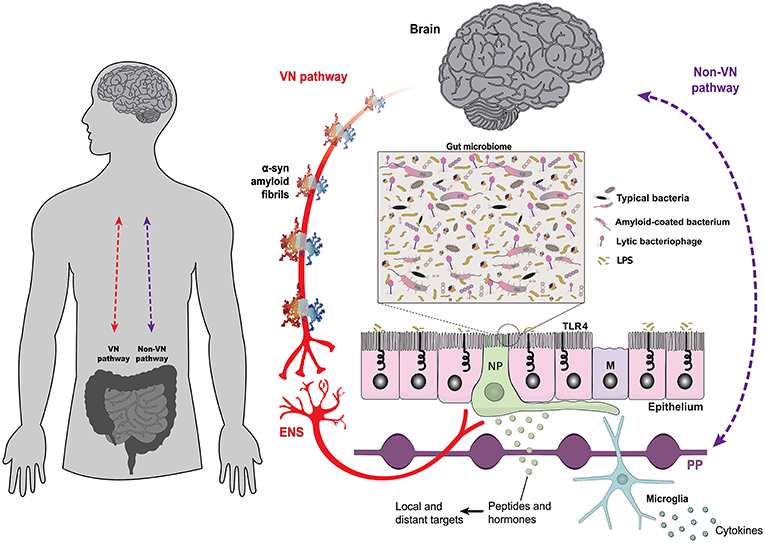
Image: Fneur-10-00574-g001 — Santos SF, de Oliveira HL, Yamada ES, Neves BC, Pereira A (CC BY 4.0), via Wikimedia Commons
Which Bacteria Are Linked to Depression?
A 2022 gut microbiome-wide association study published in Nature Communications identified 13 specific bacterial genera associated with depressive symptoms in a general population cohort. The taxonomy map below plots these genera across major phyla — Clostridia, Bacteroidia, and Verrucomicrobiae — with some showing negative associations with depression (potentially protective) and others showing positive associations (potentially harmful).

Image: The taxonomic tree showing the 13 genera associated with depressive symptoms — Radjabzadeh D, Bosch JA, et al. (CC BY 4.0), via Wikimedia Commons
Notable from that study: genera within Eggerthella showed the strongest positive association with depressive symptoms, while genera in Coprococcus and Ruminococcaceae groups showed protective negative associations. This is not coincidental — Coprococcus is a major butyrate producer, and butyrate has established anti-inflammatory and neuroprotective effects. These patterns provide a mechanistic rationale for the dietary strategies discussed later in this article.
ADHD: The Latest Psychiatric Condition Linked to the Gut
The 2026 review by Sadowska and Hart in the Journal of Human Nutrition and Dietetics synthesized clinical evidence and found consistent patterns across ADHD research:
- Altered composition of Lachnospiraceae and Ruminococcaceae families in ADHD populations compared to neurotypical controls
- Reduced overall microbial diversity in ADHD patients, with lower diversity correlating with greater symptom severity in some cohorts
- Preliminary evidence that omega-3 supplementation — known to modestly benefit ADHD symptoms — may partly act through microbiome modulation
- Small probiotic trials showing modest reductions in inattention scores, though the authors note these studies are too small and short-term for clinical recommendations
The authors are appropriately cautious about causality. ADHD-associated selective eating behaviors can themselves produce an atypical microbiome, making it difficult to determine whether the gut changes drive symptoms or follow from them. The bidirectional nature of the gut-brain axis means both directions likely contribute.
Diet Imbalances Disrupt the Gut-Brain Axis
A 2026 study in Food Research International (Chen et al.) demonstrated that both long-term low-salt and high-salt diets differentially disrupt the gut-metabolite-brain axis in animal models, producing measurable cognitive impairment through distinct metabolic pathways. While extreme dietary conditions in animal models don't map directly to typical human experience, the finding reinforces that daily dietary choices modulate the gut-brain axis continuously — not just through the microbiome's bacterial composition, but through the metabolites those bacteria produce in response to what we eat.
Dietary Strategies That Support the Gut-Brain Axis
| Strategy | Primary Mechanism | Evidence Level |
|---|---|---|
| Mediterranean diet | Feeds Bacteroidetes, reduces pro-inflammatory bacteria | Strong — multiple cohort studies |
| Fermented foods (kefir, kimchi, yogurt) | Increases microbial diversity, lowers inflammatory markers | Moderate — RCT evidence |
| Prebiotic fiber (inulin, FOS) | Feeds Bifidobacterium, boosts SCFA and serotonin production | Moderate — consistent across studies |
| Targeted probiotic strains | Strain-specific effects on serotonin, GABA, inflammation | Emerging — early trials promising |
| Reducing ultra-processed foods | Restores Bifidobacterium and Lactobacillus populations | Moderate — intervention studies |
Psychobiotics: The Emerging Clinical Frontier
The term "psychobiotic" — coined to describe live organisms, prebiotics, and dietary interventions specifically studied for mental health effects — has moved from academic novelty to an active clinical research area. Current investigations include:
- Specific probiotic strains administered alongside SSRIs in treatment-resistant depression trials
- Fecal microbiota transplantation (FMT) for severe, medication-resistant depression, with pilot data showing mood improvements in some patients
- Structured dietary prescription protocols as formal adjuncts in ADHD management, particularly in pediatric populations where medication side effects are a significant concern
None of these approaches has reached regulatory approval as a psychiatric treatment. What is clear is that the gut microbiome is no longer a peripheral footnote in psychiatry — it is becoming a recognized variable in how mental health conditions develop, persist, and respond to treatment.
Frequently Asked Questions
Can probiotics treat depression on their own?
Not as a standalone treatment supported by current evidence. Several trials have shown modest improvements in depression scores when specific probiotic strains are taken alongside conventional antidepressants, suggesting an additive benefit. No probiotic is approved as a psychiatric treatment. Anyone considering supplementation for mental health purposes should discuss it with their healthcare provider rather than substituting it for established care.
How quickly does diet change the gut microbiome?
Measurable shifts in microbiome composition can occur within 3–4 days of significant dietary change. However, the stable, long-term microbial profiles associated with better mental health outcomes require weeks to months of consistent dietary patterns to establish and maintain. A one-week dietary experiment is unlikely to produce lasting mental health effects, though it does demonstrate just how responsive the microbiome is to what we eat.
Is commercial microbiome testing useful for mental health decisions?
Not at this stage. Research tools can identify population-level associations between specific taxa and mood disorders, but direct-to-consumer microbiome tests are not clinically validated for psychiatric applications. They cannot yet tell you which bacteria you personally should cultivate for mental health benefit. The science is advancing rapidly, but individualized clinical utility remains a near-future goal rather than a present reality.
Bottom Line
The gut-brain axis is not a fringe concept — it is a documented, multimechanistic communication system with real implications for psychiatric health. We recommend treating your microbiome as a genuine mental health variable: eat a diverse, fiber-rich diet, include fermented foods regularly, and recognize that ultra-processed dietary patterns harm more than just metabolic health. The clinical applications of psychobiotics are still developing, but the dietary patterns that support microbiome health are already established as broadly beneficial — and the evidence that they also support mental health is now substantial enough to act on.
Sources & References:
Sadowska K, Hart K. Gut Microbiome and ADHD: A Narrative Review of Clinical Evidence and Practice Implications. J Hum Nutr Diet. 2026;39(4):e70327. PMID 42543801
Chen A, et al. Long-term low-salt and high-salt diets differentially disrupt the gut-metabolite-brain axis and induce cognitive impairment. Food Res Int. 2026;241:119719. PMID 42562493
Radjabzadeh D, Bosch JA, et al. Gut microbiome-wide association study of depressive symptoms. Nat Commun. 2022;13:7128.
Disclaimer: This article is for informational purposes only and does not constitute medical advice. Always consult a qualified healthcare professional before making health decisions.