
A 2026 study published in Journal of Affective Disorders found that reduced slow-wave (deep) sleep is significantly linked to suicidal ideation in people with major depressive disorder — a striking reminder of just how much that one specific sleep stage affects mental health. Separate research published the same year confirmed that slow-wave sleep is the window during which the brain consolidates newly acquired memories and restores cognitive function. Yet most adults rarely think about whether they're actually getting enough deep sleep, only whether they're getting enough sleep overall.
That distinction matters. You can log eight hours in bed and still emerge groggy if your deep sleep — also called slow-wave sleep (SWS) or N3 — was cut short. Here's what we know, and what actually works to get more of it.
What Happens During Deep Sleep
Sleep cycles through four stages roughly every 90 minutes. The first two are lighter (N1 and N2); the third, N3, is where deep sleep occurs. It's characterized by slow, high-amplitude delta brain waves (0.5–4 Hz), a drop in heart rate and blood pressure, and the release of the majority of the night's growth hormone.
During N3, the brain runs what researchers call a "save" operation on the day's experiences — transferring short-term memory traces from the hippocampus into longer-term cortical storage. The body also repairs tissue, strengthens the immune system, and clears metabolic waste products from the brain through the glymphatic system. The first half of the night is when the bulk of deep sleep occurs; the second half shifts toward REM.
Adults typically need 13–23% of their total sleep time in N3. For a seven-hour sleeper, that's roughly 55–95 minutes. Deep sleep naturally declines with age starting around age 30, dropping significantly each decade, which is why sleep quality — not just quantity — deserves attention.
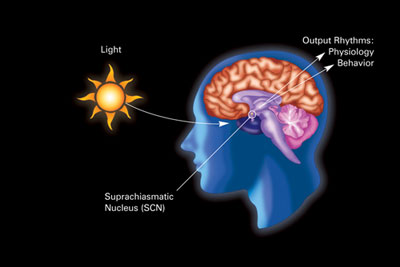
Image: Circadian rhythm labeled — National Institute of General Medical Sciences (Public domain), via Wikimedia Commons
Why Deep Sleep Gets Disrupted
Several common habits and conditions fragment or suppress slow-wave sleep:
- Alcohol — Even moderate amounts suppress N3 in the second half of the night. Alcohol may help you fall asleep faster, but it costs you deep sleep quality.
- Irregular sleep timing — The circadian clock (centered in the suprachiasmatic nucleus in the brain, as shown above) times deep sleep to specific biological windows. Shifting your schedule disrupts this timing.
- Caffeine — Caffeine blocks adenosine receptors. Since adenosine buildup drives sleep pressure, caffeine consumed late in the day reduces the total amount of slow-wave sleep your brain recovers.
- Sleep apnea — Repeated arousals from airway obstruction fragment the deepest sleep stages first. Many people with untreated sleep apnea get almost no N3.
- Stress and high cortisol — Cortisol is physiologically antagonistic to the slow-wave state. Elevated evening cortisol is one of the most consistent predictors of poor deep sleep.
- Artificial light at night — Blue-spectrum light suppresses melatonin onset, which is the signal that starts the transition toward deep sleep.
Evidence-Based Ways to Increase Deep Sleep
No single intervention guarantees more deep sleep, but several have consistent evidence behind them:
Regular Aerobic Exercise
Aerobic exercise is one of the most well-studied deep-sleep enhancers. Multiple controlled studies show that moderate-intensity aerobic activity (running, cycling, swimming) increases slow-wave sleep duration and depth of delta-wave activity compared to sedentary controls. Timing matters: morning or early-afternoon exercise tends to produce larger benefits than late-evening workouts, which can raise core temperature and delay sleep onset. Resistance training also improves sleep quality, though the delta-wave effect is somewhat smaller.
Sleep Schedule Consistency
Your deep sleep is timed to your circadian rhythm, not just to how long you've been awake. Waking at the same time every day — including weekends — anchors your circadian clock, which in turn anchors the timing of N3. Even one or two late nights per week can fragment the schedule enough to reduce deep sleep the following nights.
Sleep Environment Temperature
A drop in core body temperature is one of the key physiological triggers for entering N3. Sleeping in a cool room (roughly 65–68°F / 18–20°C) supports this natural drop. Counterintuitively, taking a warm bath or shower 60–90 minutes before bed also helps: the warm water causes peripheral vasodilation, which dumps body heat quickly and accelerates core cooling once you get out.
Eliminate or Sharply Limit Alcohol
This is the single most impactful change for many people. Alcohol disrupts deep sleep architecture dose-dependently — one to two drinks reduces N3, and higher doses can suppress it dramatically. If you drink, finishing well before bedtime (at least three to four hours) reduces but doesn't eliminate the impact.
Caffeine Cutoff Earlier Than You Think
Caffeine's half-life is approximately five to six hours in most people, but the quarter-life is ten to twelve hours. A 3pm coffee still has about 25% of its concentration in your system at 3am. Experiment with moving your last caffeine consumption to before noon if you're struggling with deep sleep.
Melatonin, Light, and the Circadian Connection
Melatonin is widely misunderstood as a "sleep hormone" that directly produces drowsiness. It's more accurately a darkness signal — it tells the brain that night has arrived, which helps time sleep onset and, indirectly, the sequence of sleep stages. As the chart below shows, melatonin production ramps up sharply in the evening, peaks around 2–3am, and falls rapidly toward morning.

Image: Melatonin production in 24 hour cycle — Rechargeenergy (CC BY-SA 4.0), via Wikimedia Commons
Supplemental melatonin can help shift the timing of sleep onset — useful for jet lag, shift work, or delayed sleep phase — but it doesn't specifically increase the duration or depth of N3. If your melatonin timing is already appropriate and you're still not getting enough deep sleep, the problem lies elsewhere.
Morning light exposure is the most powerful tool for anchoring melatonin timing. Getting bright natural light (preferably outdoors) within an hour of waking suppresses residual melatonin sharply and sets the circadian clock. This morning signal determines when melatonin rises again that evening. Blocking bright light for two hours before bed — especially the blue-spectrum light from screens — protects the rising melatonin phase.
Deep Sleep Optimization: Method Comparison
| Method | Evidence Strength | Time to Effect | Effort Level |
|---|---|---|---|
| Consistent wake time | Strong | 1–2 weeks | Low |
| Regular aerobic exercise | Strong | 2–4 weeks | Moderate |
| Cool bedroom (18–20°C) | Moderate | Immediate | Low |
| Eliminate evening alcohol | Strong | Immediate | Variable |
| Earlier caffeine cutoff | Moderate | 1–3 days | Low |
| Morning light exposure | Moderate | 1–2 weeks | Low |
| Evening blue light block | Moderate | 1–7 days | Low |
| Stress/cortisol reduction | Moderate | 2–6 weeks | High |
Frequently Asked Questions
How much deep sleep do adults actually need per night?
Sleep researchers generally consider 13–23% of total sleep time in N3 to be healthy for adults. For someone sleeping seven hours, that's roughly 55–95 minutes. Most consumer wearables measure sleep stages using movement and heart rate (rather than EEG), so treat their deep sleep estimates as directional rather than precise. If you consistently feel rested and cognitively sharp, you're likely getting enough regardless of what a tracker reports.
Does the amount of deep sleep decline as you age, and is that fixable?
Yes — deep sleep naturally declines significantly with age. Adults over 60 often get half the N3 time they did in their 30s. Some of this is biological and unavoidable, but much of the additional decline seen in older adults is attributable to lifestyle factors: less physical activity, more alcohol, more fragmented schedules, and higher rates of sleep-disordered breathing. Addressing those factors can meaningfully preserve or partially restore deep sleep at any age.
Can supplements like magnesium or glycine increase deep sleep?
Some research suggests magnesium supplementation may modestly improve sleep quality, possibly by supporting GABA (an inhibitory neurotransmitter). Glycine, an amino acid, has shown small benefits in controlled studies. However, the evidence is weaker and less consistent than the behavioral interventions listed above. If you're already doing the basics — consistent schedule, exercise, no alcohol, cool room — supplements may offer marginal additional benefit for some people, but they're not a substitute for the foundations.
The Bottom Line
Deep sleep is not a passive outcome of spending time in bed — it's actively shaped by how you move, eat, drink, and structure your day. The behaviors with the most consistent evidence are also the simplest: wake at the same time every morning, exercise aerobically several times per week, cut alcohol from your evening routine, and sleep in a cool, dark room. If you do nothing else, implementing just those four changes gives you the best possible foundation for getting more N3. Supplements and sleep trackers can be useful additions once the fundamentals are solid — but they don't replace them.
Sources & References:
Reduced Slow-Wave Sleep and Sleep-Disordered Breathing Are Linked to Suicidal Ideation in Major Depressive Disorder — PubMed (PMID 42608943, Aug 2026)
Sleep and memory consolidation: Neural and cognitive perspectives — PubMed (PMID 42547206, 2026)
Disclaimer: This article is for informational purposes only and does not constitute medical advice. Always consult a qualified healthcare professional before making health decisions.