
A 2026 randomized controlled trial published in the Journal of Human Nutrition and Dietetics found that time-restricted eating—one of the most popular forms of intermittent fasting—triggers measurable metabolic adaptations in adults with severe obesity within the early phase of weight loss. The study (de Moraes Campos et al., PMID 42277575) adds a critical nuance to the intermittent fasting conversation: your body doesn't passively burn fat during fasting windows. It actively adjusts its metabolic rate in ways that can either accelerate or undercut your results depending on how you fast.
Metabolic rate—specifically resting metabolic rate (RMR), the energy your body burns at complete rest—accounts for 60–75% of your total daily calorie burn. When intermittent fasting interacts with this number, the effects are more nuanced than "eat less, burn more." Here is what the current evidence actually shows.
What Resting Metabolic Rate Means for Intermittent Fasters
Resting metabolic rate reflects the energy your organs, muscles, and brain require just to keep you alive. When you lose weight—through any method including fasting—your RMR almost always decreases, a phenomenon called adaptive thermogenesis. The critical question is how much it decreases, and whether intermittent fasting protocols cause less adaptive reduction than traditional continuous caloric restriction.
The 2026 RCT by de Moraes Campos et al. examined this question in adults with severe obesity using time-restricted eating (TRE) during the early phase of weight loss. Their findings suggest that metabolic adaptation patterns differ based on the structure of the eating window—a detail that matters enormously for long-term weight management success and helps explain why some people plateau on IF while others do not.

Image: HPP keeps Team Schriever fit to fight (3645117) — Arielle Vasquez / U.S. Air Force (Public domain), via Wikimedia Commons
How Fasting Windows Change Metabolic Rate
The mechanism through which intermittent fasting influences metabolic rate is multi-layered. During fasting periods, circulating insulin drops sharply, signaling fat cells to release stored energy as free fatty acids. Simultaneously, growth hormone secretion increases—a protective hormonal shift that helps preserve lean muscle mass, your primary metabolic engine. During a well-structured fast, the net effect is metabolic preservation, not metabolic suppression.
However, this protection depends critically on fasting duration. The research shows three distinct zones:
- Short fasts (12–16 hours): Minimal RMR impact. The body shifts fuel sources from glucose to fat without triggering significant adaptive thermogenesis. This is the metabolic sweet spot for most 16:8 practitioners.
- Medium fasts (24–36 hours): RMR may dip temporarily by 3–8%, but typically recovers upon refeeding. Elevated growth hormone during this window continues to offer muscle protection.
- Prolonged fasts (48 hours or more): The risk of meaningful RMR reduction increases substantially. The body may down-regulate thyroid output and reduce sympathetic nervous system activity to conserve energy. These protocols require medical supervision and are inappropriate for most people as routine practice.
The Blood Sugar and Insulin Connection
One reason intermittent fasting can positively influence metabolic rate is its powerful effect on insulin and blood glucose dynamics. Under typical three-meal eating patterns, blood glucose and insulin remain elevated for much of the day—often 12–14 hours—leaving your cells in energy-storage mode rather than fat-burning mode.
Compressing your eating window fundamentally changes this. During a fasting period, insulin falls to baseline, and your metabolism shifts toward oxidizing fatty acids and producing ketone bodies. This metabolic switch—from glucose-dominant to fat-dominant fuel use—is associated with improved insulin sensitivity and, over time, greater metabolic flexibility: the ability to efficiently shift between fuel sources depending on availability.
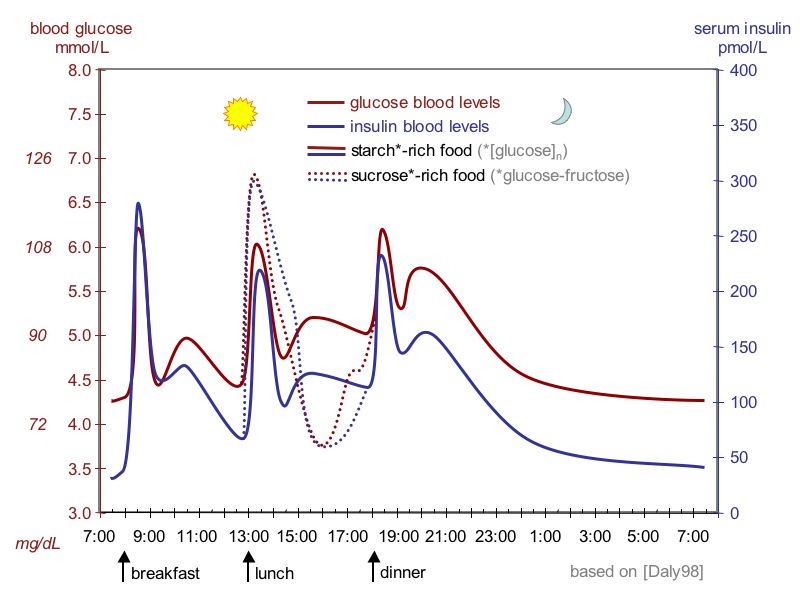
Image: Suckale08 fig3 glucose insulin day — Jakob Suckale, Michele Solimena (CC BY-SA 3.0), via Wikimedia Commons
Comparing Intermittent Fasting Protocols by Metabolic Impact
| Protocol | Eating Window | RMR Impact | Best Suited For |
|---|---|---|---|
| 16:8 TRE | 8 hours daily | Moderate preservation | Daily adherence, beginners |
| 14:10 TRE | 10 hours daily | Minimal impact | Circadian alignment, older adults |
| 5:2 Protocol | 5 normal + 2 restricted days | Variable by restriction depth | Weekly flexibility |
| OMAD (One Meal a Day) | 1–2 hours daily | Higher adaptive risk | Experienced fasters, short-term |
| Alternate Day Fasting | Alternating feast/fast | Mixed evidence | Short-term intervention, medical supervision |
Muscle Preservation: The Hidden Factor in Metabolic Rate
The biggest metabolic threat in any weight-loss plan—including fasting—is muscle loss. Since muscle tissue is metabolically expensive, burning roughly 6 calories per pound per day at rest compared to 2 calories for fat, losing muscle during weight loss directly accelerates the drop in RMR. This is why the composition of your weight loss matters more than total weight lost.
Well-structured intermittent fasting may be superior to continuous caloric restriction for preserving muscle mass. The key mechanism is the fasting-induced increase in growth hormone, which has well-documented anabolic and muscle-preserving effects. Research has shown that a 24-hour fast can produce significant growth hormone elevation—a hormonal environment that caloric restriction alone cannot replicate.
To maximize muscle preservation during IF: consume adequate protein within your eating window (0.7–1 gram per pound of body weight); include resistance training two to four times per week; avoid prolonged fasts without adequate protein refeeding; and consider placing your eating window around your training schedule to take advantage of nutrient timing.
How to Fast Without Suppressing Your Metabolism
Based on the current evidence, including the 2026 RCT on metabolic adaptation, we recommend the following approach for those seeking to preserve metabolic rate while practicing intermittent fasting:
Keep eating windows at least 6–8 hours long. Extremely compressed windows like OMAD (one meal a day) are associated with greater adaptive thermogenesis risk in some populations. A 16:8 or 14:10 window provides the fat-burning benefits of fasting without excessive metabolic suppression.
Avoid extreme caloric deficits during eating windows. Fasting 16 hours while also eating 30%+ below maintenance compounds metabolic stress. Moderate deficits of 10–20% below maintenance calories are more sustainable and preserve metabolic rate far better over months of practice.
Align your eating window with daylight hours. Circadian research consistently shows that eating earlier in the day—with your largest meal at lunch rather than dinner—optimizes the metabolic benefits of time-restricted eating. Late-night eating, even within a compressed window, partially negates circadian fasting benefits.
Incorporate periodic refeed days. Some evidence supports one or two days per week of eating at maintenance calories to signal metabolic abundance and temporarily counteract adaptive thermogenesis. This is especially relevant for those who have been in a consistent deficit for more than 8–12 weeks.
Frequently Asked Questions
Does intermittent fasting slow down your metabolism?
Brief, well-structured intermittent fasting does not meaningfully slow metabolism—in fact, short-term fasting up to 36 hours may temporarily increase metabolic rate by a small but measurable percentage due to norepinephrine release. Prolonged fasting combined with severe caloric restriction can trigger adaptive thermogenesis over weeks to months, reducing RMR. The solution is structured, moderate protocols with adequate protein intake and resistance training.
Is 16:8 intermittent fasting better for metabolism than the 5:2 method?
Both can be effective, but daily time-restricted eating like 16:8 generally offers more consistent metabolic benefits because it's practiced every day and allows for better circadian alignment of meals. The 5:2 protocol works well for many people but may produce more pronounced adaptive thermogenesis on restriction days if caloric intake falls below 500–600 calories. The best protocol is the one you sustain without excessive restriction.
How long does it take for metabolism to adapt to intermittent fasting?
The 2026 RCT by de Moraes Campos et al. found that measurable metabolic adaptations appear within the first few weeks of time-restricted eating. Full metabolic adjustment—including improved metabolic flexibility and stabilized RMR—typically occurs within four to eight weeks. This adaptation period often includes temporary fatigue and hunger signals, which usually resolve as your body becomes efficient at switching between glucose and fat as fuel sources.
Disclaimer: This article is for informational purposes only and does not constitute medical advice. Always consult a qualified healthcare professional before making health decisions.