
A 2026 systematic review published in Sleep Medicine Reviews analyzed pharmacological and behavioral interventions targeting slow-wave sleep (SWS) — the deepest stage of non-REM sleep — and found a consistent link between SWS duration and next-day cognitive performance across dozens of studies (Baandrup et al., 2026). Yet the average adult achieves only 60–90 minutes of deep sleep per night, often considerably less as they age. Understanding how much deep sleep you truly need — and what happens when you consistently fall short — is one of the most actionable steps you can take for your brain and body.

Image: EEG record of brain activity and wave patterns from a sleeping boy — Jemaleddin Cole (CC BY-SA 2.0), via Wikimedia Commons
What Is Deep Sleep, Exactly?
Your brain cycles through four sleep stages roughly every 90 minutes. The first two stages are lighter non-REM sleep. Stage 3 — also called slow-wave sleep or N3 — is deep sleep. During this phase, your brain produces large, synchronized delta waves (0.5–4 Hz). This is when growth hormone is secreted, tissues repair, immune memory consolidates, and the brain's glymphatic system actively flushes metabolic waste, including amyloid-beta plaques linked to Alzheimer's disease.
REM sleep handles emotional memory and creative processing, but slow-wave sleep does the structural maintenance work. The two are not interchangeable.
How Much Deep Sleep Do You Actually Need?
Sleep researchers generally target 13–23% of total sleep time as slow-wave sleep. For a typical 7–9 hour night, that works out to approximately 60–110 minutes. This range comes from population studies tracking polysomnography — full overnight EEG recordings — in healthy adults.
However, individual need varies significantly. Athletes in heavy training may need more. Older adults naturally get less, as SWS declines roughly 2% per decade after age 25. People recovering from illness or psychological stress often see short-term increases as the body prioritizes repair.
Why Deep Sleep Matters More Than Total Hours
A 2026 review in Frontiers in Neurology examined how sleep architecture — the proportional composition of sleep stages — interacts with exercise to influence executive function in middle-aged and older adults (Zheng et al., 2026). The finding was striking: the ratio of slow-wave sleep to total sleep time predicted working memory, processing speed, and cognitive flexibility independently of how many total hours subjects slept. You can sleep 9 hours and still have impaired executive function if those hours are fragmented or shallow.
This is why people who drink alcohol frequently report sleeping "a lot" but feel mentally foggy. Alcohol suppresses REM and SWS in the second half of the night, truncating restorative deep sleep even when total time looks adequate on a sleep tracker.
The Alzheimer's Connection: Deep Sleep as a Preventive Tool
Perhaps the most compelling reason to actively protect your deep sleep is its role in Alzheimer's pathophysiology. In 2026, researchers at the University of Pittsburgh registered the Alzheimer's Pathways Sleep Study (ALPS), a randomized controlled trial specifically designed to test whether enhancing slow-wave sleep reduces amyloid and tau burden in the brain (Dong et al., 2026). This trial reflects a scientific consensus building over the past decade: the glymphatic system — the brain's waste-clearance network — is most active during slow-wave sleep, and chronic SWS deficiency correlates with accelerated plaque accumulation.
You don't need to wait for the ALPS trial results to apply this logic. Protecting your deep sleep window is among the most plausible preventive strategies available for long-term cognitive health.
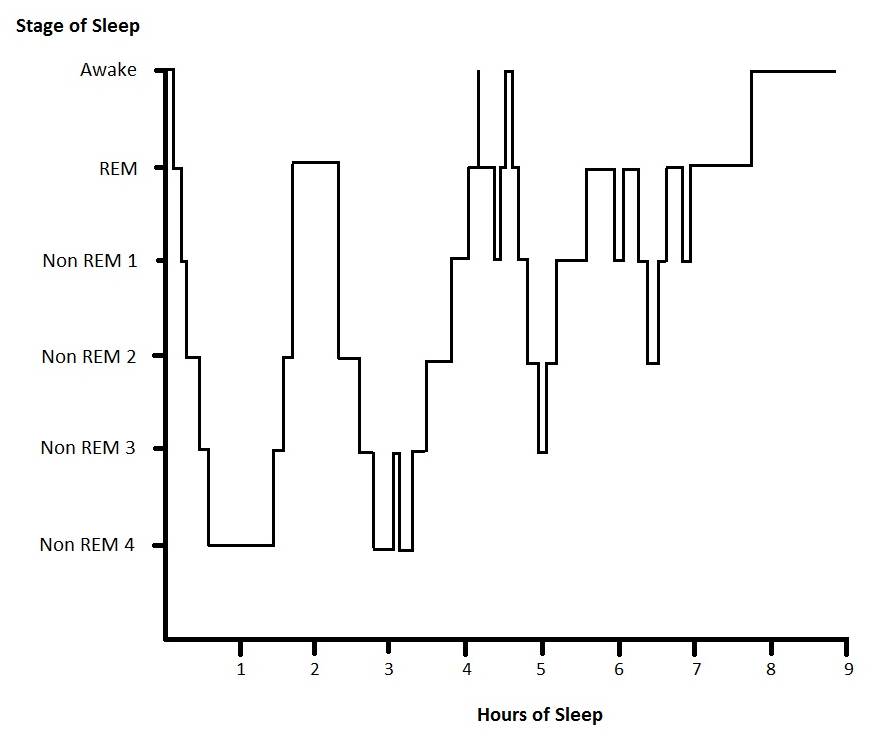
Image: HYPNOGRAM created by Natasha k — Natasha k (CC BY-SA 3.0), via Wikimedia Commons
When Deep Sleep Happens — and Why Timing Matters
The hypnogram above illustrates a key structural fact: slow-wave sleep is heavily front-loaded. The deepest and longest SWS episodes occur in the first two 90-minute cycles of the night, typically in the first 2–3 hours after sleep onset. As the night progresses, SWS episodes shrink and REM sleep expands.
This means that the most common sleep mistake — going to bed late and sleeping in — doesn't fully compensate. Cutting the front of your night by even 90 minutes can eliminate your most restorative deep sleep episode while leaving your lighter, later sleep intact. Consistent sleep onset time matters as much as total duration.
Evidence-Based Ways to Increase Deep Sleep
Several strategies have reliable support for increasing slow-wave sleep percentage:
- Consistent sleep schedule: Going to bed and waking at the same time daily — including weekends — anchors your circadian rhythm and protects SWS architecture.
- Physical exercise: Moderate aerobic and resistance exercise are among the most consistently cited non-pharmacological enhancers of slow-wave sleep. The Frontiers in Neurology review noted that regular exercise increases SWS and improves cognitive outcomes together.
- Cold sleep environment: Core body temperature must drop to initiate deep sleep. Keeping your bedroom between 60–67°F (15–19°C) facilitates this. A warm shower or bath 1–2 hours before bed accelerates the subsequent core temperature drop.
- Limiting alcohol: Even moderate evening alcohol fragments SWS in the second half of the night. Finishing drinking 3+ hours before bed reduces this effect.
- Avoiding late-night food: Eating close to bedtime raises core body temperature and may shift energy away from restorative processes. A 2–3 hour eating cutoff before sleep is broadly recommended.
- Reducing blue light exposure: Blue-spectrum light suppresses melatonin, delaying sleep onset and compressing the SWS window. Dimming screens 60–90 minutes before bed is supported by sleep research.
| Sleep Stage | % of Total Sleep | Primary Role | Timing in Night |
|---|---|---|---|
| N1 (Light) | 5% | Sleep onset transition | Throughout |
| N2 (Light-moderate) | 45–55% | Motor memory, spindle processing | Throughout |
| N3 (Deep / SWS) | 13–23% | Physical repair, immune memory, glymphatic clearance | First half of night |
| REM | 20–25% | Emotional processing, creativity, declarative memory | Second half of night |
How to Know If You're Getting Enough
Consumer sleep trackers (Oura, WHOOP, Apple Watch) estimate deep sleep through heart rate variability and movement patterns, not EEG. These estimates can be useful for tracking trends over time but are not clinically accurate. A polysomnography study from a sleep lab remains the gold standard if you suspect a sleep disorder.
Practical signals that your deep sleep may be insufficient: waking unrefreshed despite adequate hours, difficulty retaining new information, elevated afternoon fatigue, frequent illness, or slow physical recovery after exercise. These reflect SWS's core functions failing to complete.
Frequently Asked Questions
Can you catch up on lost deep sleep?
Partially. Sleep pressure — the homeostatic drive to sleep — increases slow-wave sleep rebound after deprivation. A single recovery night will increase SWS percentage. However, chronic cumulative deep sleep debt does not fully resolve with a few recovery nights, particularly for cognitive outcomes. Consistent nightly SWS is substantially more protective than catch-up sleep on weekends.
Do sleep supplements like melatonin help increase deep sleep?
Melatonin primarily helps with sleep onset timing and is most effective for jet lag or circadian rhythm disorders. It has limited direct evidence for increasing slow-wave sleep percentage. The 2026 systematic review by Baandrup et al. found that most pharmacological SWS enhancers act on GABA-A receptors or adenosine pathways — mechanisms distinct from melatonin. Lifestyle interventions (exercise, temperature, schedule consistency) have more consistent evidence for SWS enhancement in healthy adults.
Why do I feel more rested after 6 hours than 9 hours sometimes?
Sleep quality metrics explain this better than duration alone. A 6-hour night with intact deep sleep architecture can feel more restorative than 9 hours of fragmented, shallow sleep. Sleep inertia — the grogginess of waking from deep sleep — also plays a role: waking mid-SWS feels markedly worse than waking during lighter N1/N2 stages. Sleep tracking can help identify whether you're consistently waking at an unfortunate point in your cycle.
Bottom Line
Deep sleep is not a passive byproduct of lying down long enough — it is an actively regulated brain state with specific physiological functions nothing else replicates. The research reviewed here consistently points to 60–110 minutes of slow-wave sleep per night as the target range for healthy adults, with the most critical window occurring in the first half of the night. We recommend prioritizing consistent sleep timing, moderate daily exercise, and a cool, dark sleep environment as the highest-leverage interventions for improving your deep sleep quality. For anyone concerned about cognitive trajectory, protecting slow-wave sleep is one of the most science-supported preventive strategies currently available.
Sources & References:
Baandrup L, Gholy SM, García-Borreguero D. Pharmacological interventions to enhance slow wave sleep and cognitive performance: a systematic review. Sleep Med Rev. 2026;87:102280.
Zheng W, Huang L, Wu M, Chen Y. The interplay of sleep architecture and exercise in executive function of middle-aged and older adults. Front Neurol. 2026;17:1839841.
Dong YC et al. The Alzheimer's Pathways Sleep Study (ALPS): an experimental randomized controlled trial to improve cognition and Alzheimer's pathophysiology through slow-wave sleep. Trials. 2026;27(1).
Disclaimer: This article is for informational purposes only and does not constitute medical advice. Always consult a qualified healthcare professional before making health decisions.