
When researchers at Maastricht University published a 2026 clinical trial in The Journal of Nutrition, the result was striking. Older male participants who consumed 20 grams of a plant-derived protein blend showed no significant increase in muscle protein synthesis (MPS) rates — even when the blend was supplemented with additional leucine or combined with whey protein. The implication is clear: in older muscles, plant protein strategies that seem adequate on paper may be quietly failing to do the job.
What Muscle Protein Synthesis Actually Is
Muscle protein synthesis is the biological process by which cells build new proteins from amino acids — the raw material for maintaining, repairing, and growing skeletal muscle. Throughout life, MPS and muscle protein breakdown run in constant balance. When synthesis consistently outpaces breakdown, muscle grows. When breakdown wins, muscle shrinks.
In youth, this balance is easy to tip toward synthesis. A protein-rich meal triggers a robust anabolic response: amino acids flood the bloodstream, leucine activates the mTORC1 signaling pathway, and muscle fiber construction ramps up. In older adults, this response is blunted — a phenomenon researchers call anabolic resistance. The same protein dose that drives clear MPS gains in a 25-year-old produces a far weaker response in a 65-year-old. Getting this wrong over years translates directly into sarcopenia: the progressive, age-related loss of skeletal muscle mass and strength that raises fracture risk, reduces mobility, and undermines metabolic health.
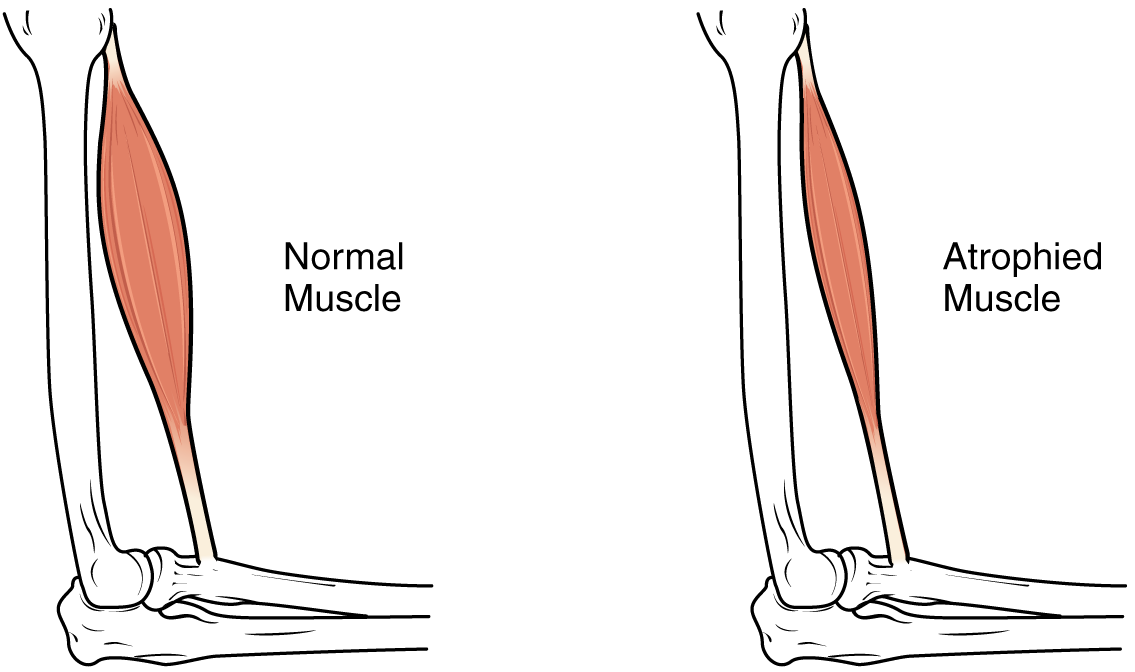
Image: File:1025 Atrophy.png — OpenStax (CC BY 4.0), via Wikimedia Commons
Why Older Muscles Resist the Anabolic Signal
Anabolic resistance in aging muscles has several interacting causes. Gastric emptying slows with age, reducing the peak amino acid spike that triggers MPS. The mTORC1 pathway — the central switch for protein synthesis — becomes less sensitive to leucine. Chronic low-grade inflammation (inflammaging) interferes with anabolic signaling. And splanchnic retention increases, meaning the liver and gut hold back a greater proportion of dietary amino acids before they reach muscle tissue.
The net result: older adults require a meaningfully stronger protein stimulus to achieve the same MPS response as younger people. A 2022 systematic review and meta-analysis in the International Journal of Environmental Research and Public Health (Naseeb & Volpe, PMID 35886571) confirmed that inadequate protein intake in older adults is significantly associated with higher sarcopenia risk — a finding with major implications for independence and longevity.
The 2026 Trial: What Specifically Failed
The Maastricht University trial (Kuin et al., The Journal of Nutrition, August 2026; PMID 42607838) tested three conditions in older males: 20 grams of a plant-derived protein blend alone, the same blend with added leucine, and the blend combined with whey protein. None of the three produced a statistically significant increase in muscle protein synthesis rates.
This matters for several reasons. Adding leucine — often proposed as the "fix" for lower-leucine plant proteins — did not rescue the anabolic response. Adding whey on top of plant protein, rather than replacing it, also failed to compensate. The results point to more than amino acid composition: the digestibility, absorption kinetics, and overall anabolic signaling capacity of these plant protein combinations were insufficient to overcome the anabolic resistance of aging muscle at a 20-gram dose.
How Much Protein, and From What Sources
The PROT-AGE Study Group — an international expert panel — published position guidelines in the Journal of the American Medical Directors Association recommending that healthy older adults consume at least 1.0–1.2 grams of protein per kilogram of body weight per day, with 1.2–1.6 g/kg/day for physically active individuals. These targets exceed the standard RDA of 0.8 g/kg/day, which was designed to prevent deficiency, not to optimize muscle maintenance. For a 70-kilogram person, the PROT-AGE recommendation translates to 84–112 grams daily — far above what most older adults actually consume.

Image: File:Amino Acids React to Form Proteins.png — Unknown author (CC BY-SA 4.0), via Wikimedia Commons
Protein Quality Comparison: What the Evidence Supports
| Protein Source | Leucine Density | Digestibility | MPS Efficacy (Older Adults) |
|---|---|---|---|
| Whey protein isolate | Very high (~11g per 100g protein) | Very high (fast-absorbing) | Excellent |
| Eggs | High (~8.5g per 100g protein) | High | Very good |
| Chicken / fish | High (~8g per 100g protein) | High | Very good |
| Soy protein isolate | High (~7–8g per 100g protein) | High | Good (best plant option) |
| Pea protein | Moderate | Moderate | Moderate; higher doses needed |
| Mixed plant blend | Variable, often lower | Variable | Lower; 20g insufficient per 2026 trial |
Meal Timing, Distribution, and the Exercise Factor
Beyond source and total amount, two factors powerfully shape MPS outcomes in older adults: meal distribution and resistance exercise.
Distribution: Spreading protein intake evenly across three to four meals — rather than loading it into one large evening meal — is consistently more effective for maximizing daily MPS. Targeting 30–40 grams of high-quality protein per meal, including breakfast, is a practical framework. A typical pattern where older adults eat minimal protein at breakfast and a large serving at dinner is poorly matched to aging muscle biology.
Resistance exercise: No dietary strategy matches the MPS-amplifying power of resistance training. Lifting weights or performing structured resistance movements sensitizes muscle to amino acids for 24 to 48 hours post-exercise, substantially amplifying the protein synthesis response to a subsequent meal. In older adults with anabolic resistance, this window of enhanced sensitivity is especially important to capture. Even modest resistance work — bodyweight movements, resistance bands, or supervised gym sessions twice per week — provides meaningful benefit when paired with adequate protein.
When resistance exercise and optimized protein intake are combined, older adults can and do build muscle — not just slow its loss. Studies of adults well into their 70s and 80s show genuine hypertrophy with appropriately structured programs.
Practical Protocol for Adults Over 50
Based on the current evidence, we recommend the following framework:
- Total intake: Aim for 1.2–1.6 g/kg/day of total protein. A 70 kg person needs roughly 84–112 grams daily.
- Per-meal dose: Each main meal should contain at least 30–40 grams of high-quality protein to reliably exceed the leucine threshold in aging muscle.
- Source priority: Whey, eggs, chicken, fish, and dairy rank highest. If relying on plant proteins, increase total amounts and lean toward soy as the most anabolically effective plant option.
- Exercise timing: Consume a high-quality protein meal within 1–2 hours after resistance training sessions.
- Don't skip breakfast protein: A high-protein morning meal counters overnight fasting-related MPS suppression.
Frequently Asked Questions
Can older adults actually build new muscle, or only slow muscle loss?
Both are achievable. With sufficient protein intake and consistent resistance exercise, most older adults can build genuine muscle mass, not just preserve what they have. The process is slower than in youth due to anabolic resistance, but studies of adults in their 70s and 80s show real hypertrophy responses. The key is pairing adequate protein with progressive resistance training — neither alone is as effective as the combination.
Does higher protein intake harm kidney function in older adults?
For healthy older adults without pre-existing kidney disease, evidence does not support that protein intakes in the 1.2–1.6 g/kg/day range cause harm. Concerns about protein and kidney stress apply primarily to individuals with diagnosed chronic kidney disease, who should follow personalized guidance from their healthcare team. Healthy kidneys handle higher protein loads without clinically meaningful strain.
If leucine supplementation didn't work in the 2026 trial, what does that mean for BCAA supplements?
The 2026 trial's negative finding for leucine-enriched plant protein suggests that leucine alone, added to an already inadequate protein matrix, may not rescue MPS in older adults at the doses tested. Branched-chain amino acid supplements that supply leucine without a full complement of essential amino acids are even less likely to drive MPS on their own — MPS requires all essential amino acids in adequate quantities, not leucine in isolation. A complete, high-quality protein source remains the more evidence-backed approach.
Bottom Line
The 2026 Maastricht University trial is a concrete reminder that assumptions about plant protein adequacy in older adults deserve scrutiny. We recommend that adults over 50 target 1.2–1.6 g/kg/day of total protein from high-quality sources, distribute that intake deliberately across meals with a real breakfast serving, prioritize leucine-dense options like whey, eggs, chicken, and fish — or soy for plant-based eaters — and combine this with consistent resistance training to unlock the exercise-sensitized MPS window. The research is clear that getting protein right in the second half of life is one of the highest-leverage investments in physical function and independence.
Sources & References:
Kuin LME et al. "Ingestion of 20 g of a plant-derived protein blend with and without added leucine or whey protein does not increase muscle protein synthesis rates in older males." The Journal of Nutrition, 2026. PMID 42607838.
Naseeb MA, Volpe SL. "Protein Intake and Sarcopenia in Older Adults: A Systematic Review and Meta-Analysis." International Journal of Environmental Research and Public Health, 2022. PMID 35886571.
Bauer J et al. "Evidence-based recommendations for optimal dietary protein intake in older people: a position paper from the PROT-AGE Study Group." Journal of the American Medical Directors Association, 2013. PMID 23867520.
Disclaimer: This article is for informational purposes only and does not constitute medical advice. Always consult a qualified healthcare professional before making health decisions.